
Machine Guarding · Die Safety Blocks
Die safety blocks, sized to your press.
Adjustable and fixed press safety blocks in certified 6061-T6 aluminum — from 1-lb ram blocks for a punch press to 250-ton fixed blocks cut to 92 inches — with power cut-off interlocks designed to keep the press from cycling while the block is in the die.
30 years of machine guarding · Certified 6061-T6 aluminum · Quotes within one business day
The requirement
If hands go in the die, a block goes in first.
Safety blocks go in whenever an operator, setup, or maintenance person has any body part in the die or platen area where an unexpected stroke could cause injury. On mechanical power presses that’s the letter of OSHA law; on everything else the same falling-ram hazard falls under OSHA’s general machine-guarding rule (1910.212) — and the fix is the same: a correctly sized block in the die space with the press locked out.
“The employer shall provide and enforce the use of safety blocks for use whenever dies are being adjusted or repaired in the press.”
— OSHA 1910.217(d)(9)(iv)
The letter of 1910.217 covers mechanical power presses. The same hazard — and the same blocks — applies on hydraulic presses, punch presses, injection molding machines, and stamping & drawing presses, and the practice belongs on press brakes too.
Correct length is critical.
Manufacturer sizing guidance: maximum 0.250″ of daylight between the top of the block and the die — or the slide, if the die is absent. More than a quarter inch and a moving slide loads the block dynamically instead of statically, a force far beyond its rating. When in doubt, we’ll size it from the press specs you provide.
The range
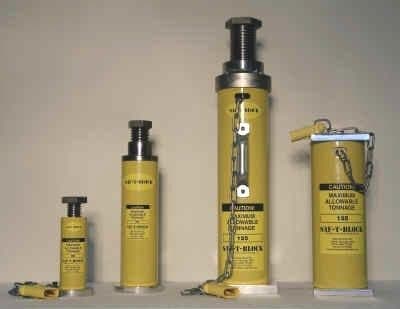
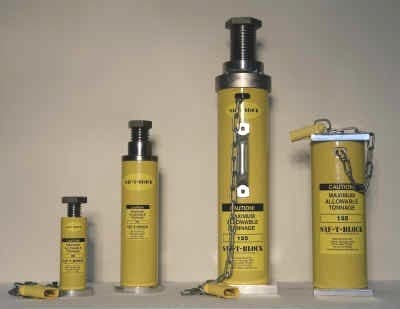
Press safety blocks — 5-ton ram blocks to 250-ton fixed.
All our safety blocks for presses are high-strength 6061-T6 / T651 aluminum extrusions, available in a complete range of sizes — adjustable screw models for varying die heights, fixed blocks cut to your die space.
Three sizes. The Hex Jr. series covers the small end — punch presses and press brakes — with models from 2″ up to 12″ of adjustment at 1–2 lb per block.
Lengths in 1-inch increments up to 60″, with 5″ to 12″ of screw adjustment.
Lengths in 1-inch increments up to 60″, with 5″ to 12″ of screw adjustment.
Lengths in 1-inch increments; standard screw adjustment is 5″.
Three capacities, five profiles, lengths from 4″ to 92″ — cut to your die space.
Send press type, tonnage, and the opening you need to fill — we’ll spec the block, accessories, and interlock from the specs you provide, in one quote.
Request a quoteOptions that do the enforcing
The interlock makes the block a system.
ANSI B11.19 — the consensus standard for safeguarding — calls for die safety blocks to be interlocked with the machine control. These are the pieces that get you there.
The block hangs in a holder on the press with a safety plug wired into the control circuit. Block in the holder — press runs. Block in the die space, plug disconnected — the press can't be cycled. When wired into the press control circuit per the manufacturer's instructions, it supports your OSHA 1910.147 energy-control procedure — the plug doesn't replace locking out the press; it keeps the control circuit open while the block is in the die. The interlock's Woodhead safety plug and receptacle hardware is UL listed and CSA certified.
Prevent damage to the block that would quietly reduce its effective tonnage rating. Strongly recommended, top and bottom.
Fill the last of the gap between the block and the ram so the block is loaded square. Aluminum is the most durable and preferred.
Handles make longer and heavier blocks safe to place (two recommended on long blocks). Holders give each block a designated home next to the electrical connection, with a rubber retention strap.
Why aluminum — and never steel.
Certified 6061-T6 aluminum has higher extruded strength per cubic inch than magnesium, and when overloaded it deforms — it doesn’t shatter. Magnesium is supposed to fracture at a 45-degree angle but can throw shrapnel. Steel should never be used as a die safety block for the same reason. Use only certified material with a documented static rating.
Die safety block questions, answered.
When does OSHA require die safety blocks?
When does OSHA require die safety blocks?
For mechanical power presses, OSHA 1910.217(d)(9)(iv) says the employer shall provide and enforce the use of safety blocks whenever dies are being adjusted or repaired in the press. The practice is the same on any press: any time hands or any body part are in the die space or under the ram — die setting, maintenance, jam clearing — a properly sized safety block goes in and the press is locked out.
What size safety block do I need?
What size safety block do I need?
Measure the opening the block has to fill and — per manufacturer sizing guidance — leave no more than 0.250″ of daylight between the top of the block and the die (or the slide, if the die is out). Any more than a quarter inch and a falling slide hits the block dynamically instead of resting on it statically — which is a different, much larger force than the block's static rating. If you're not sure, send us your press specs and we'll size it from the specifications you provide.
Why aluminum instead of steel or magnesium?
Why aluminum instead of steel or magnesium?
Certified 6061-T6/T651 aluminum extrusions offer higher strength per cubic inch than magnesium and, critically, aluminum deforms rather than shatters when overloaded. Magnesium is supposed to fracture at a 45-degree angle but can throw shrapnel; steel should never be used as a safety block for the same reason. Every block we quote is certified aluminum.
Do safety blocks work on press brakes and hydraulic presses?
Do safety blocks work on press brakes and hydraulic presses?
Yes. Blocks are used on mechanical stamping presses, hydraulic presses, punch presses, injection molding presses, and press brakes. Small-footprint ram blocks (like the Hex Jr. series, 5-ton, 1–2 lb) are made specifically for smaller punch presses and press brakes, and adjustable hex blocks can also free a hydraulic press that has drifted down onto a block, following the manufacturer's procedure.
What is a safety block interlock?
What is a safety block interlock?
An electrical cut-off that makes the block enforce itself: while the block hangs in its holder, its safety plug completes the control circuit and the press runs; take the block out to put it in the die space and the plug disconnects, making the press inoperative. It backs up your lockout/tagout procedure — it doesn't replace it — and is designed to prevent anyone from hitting cycle while you're in the die.
Request a safety block quote.
Blocks, accessories, and interlocks — priced within one business day. Prefer to talk? (281) 265-2832
This page is general safety information, not legal or engineering advice. OSHA compliance, lockout/tagout procedures, and the final selection and installation of safeguarding remain the employer’s responsibility.